
February 20, 2026
Why AI Will Not Replace Cosmetology
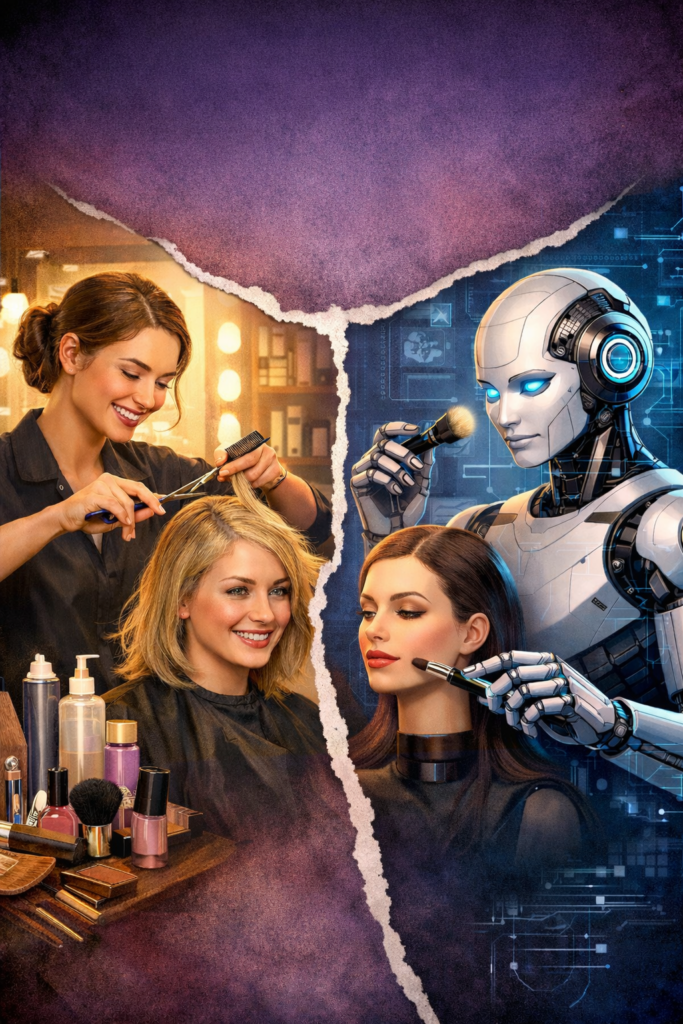
Will AI replace cosmetology? AI is transforming many industries, which is why more people are asking if their career is truly “AI safe.” But cosmetology is built on hands-on skills, creativity, and human connection—things technology simply can’t replace.
Below, we break down the key reasons why this is the case:
- Cosmetology is a hands-on, physical profession
- Beauty services depend on human connection
- Creativity cannot be automated
- Licensing, safety, and professional judgment require human expertise
- Technology supports rather than replaces cosmetologists
- Cosmetology offers long-term career security
Cosmetology Is a Hands-On, Physical Profession
The most obvious reason AI cannot replace cosmetologists is that beauty services require physical, hands-on work. A haircut, color application, facial treatment, or nail service must be performed in person by a trained professional. No algorithm or robot can replicate the tactile precision, manual dexterity, and real-time adjustments that cosmetologists make during every service.
Cutting hair requires feeling the texture, weight, and movement of each strand. Applying color involves an understanding of how products react to different hair types, along with the ability to adjust formulas based on what you see and feel during the process. Skincare treatments require assessing skin conditions through touch and observation, then adapting techniques accordingly.
That’s why so many students are drawn to cosmetology at La’ James. It’s a career that blends creativity with real, hands-on skills.
Beauty Services Depend on Human Connection
Beyond the physical requirements, cosmetology thrives on human connection. Clients don’t just come to salons for a service; they come for an experience built on trust, communication, and personal relationships.
A successful cosmetologist listens to what clients want, reads between the lines of what they’re saying, observes their body language, and asks the right questions to understand their lifestyle and preferences. This requires emotional intelligence that AI fundamentally lacks.
Clients share their lives with their stylists, estheticians, and nail technicians. They seek advice, celebrate life events, and find comfort in these relationships. The salon chair is often a safe space for conversation and connection. This human element cannot be replicated by technology, no matter how advanced.
Moreover, client comfort and trust are essential to delivering quality services. People need to feel safe and understood when someone is working on their appearance. Building this trust requires authenticity, empathy, and interpersonal skills that only humans possess.
Creativity Cannot Be Automated
Cosmetology is an art form that requires creative decision-making in real time. While AI can analyze trends and generate design ideas, it cannot interpret those trends for individual clients or make the artistic judgments that define excellent cosmetology work.
Every client is unique. The same haircut looks different on different face shapes, hair textures, and body types. A color that works beautifully on one person may not suit another. Cosmetologists must assess numerous variables, includingskin tone, eye color, lifestyle, maintenance commitment, professional requirements, and personal style, and create customized solutions.
This creative problem-solving happens in the moment. When a client brings in a photo of a celebrity hairstyle, the cosmetologist must translate that inspiration into something that works for the client’s specific features and hair type. This requires artistic vision, technical knowledge, and the ability to communicate why certain adaptations are necessary.
AI might suggest styles based on algorithms, but it cannot execute them with the nuance and personalization that clients deserve. The beauty industry values individuality and self-expression, qualities that rely on human creativity and judgment.
Licensing, Safety, and Professional Judgment
Cosmetology is a licensed profession with strict safety, sanitation, and ethical standards, especially in states like Iowa.
State licensing boards require cosmetologists to complete extensive education covering anatomy, chemistry, infection control, and safe product application. Licensed professionals must demonstrate competency in these areas and maintain their knowledge through continuing education.
To work legally in Iowa, professionals must meet state requirements, including obtaining the Iowa cosmetology license and keeping it up to date.
If something goes wrong during an automated process, who is responsible? Cosmetology’s licensing structure ensures that trained professionals are accountable for their work and equipped to handle the complexities and risks inherent in beauty services.
How Technology Supports Rather Than Replaces Cosmetologists
While AI won’t replace cosmetologists, technology does play an increasingly important role in supporting the beauty industry. Understanding this distinction is important for the cosmetology career outlook.
AI and technology assist cosmetologists in several ways. Online booking systems streamline scheduling and reduce no-shows, social media platforms showcase work and attract clients, virtual consultation tools help visualize potential results, inventory management software tracks products and supplies, and trend analysis tools identify emerging styles and techniques.
These tools make cosmetologists more efficient and help them serve clients better. Virtual try-on apps, for example, can show clients what different hair colors might look like before committing to the service. But the actual color application still requires a skilled professional.
Why Cosmetology Offers Long-Term Career Security
The future of cosmetology remains strong for several compelling reasons, especially in local markets like Iowa, where demand for skilled professionals continues across cities like Des Moines, Cedar Rapids, and Davenport.
First, demand for personal care services remains constant regardless of economic conditions. People continue to need haircuts, color services, and grooming even during recessions, making the beauty industry remarkably resilient.
Second, the industry offers diverse career paths that provide flexibility and opportunities for growth. Licensed cosmetologists can work in salons, spas, resorts, on cruise ships, in film and television, in education, in product sales, or open their own businesses. This versatility provides career security even as individual opportunities evolve.
Third, as automation displaces workers in other industries, hands-on careers like cosmetology become increasingly valuable. The human skills vs AI jobs comparison consistently identifies personal service professions as among the most protected from automation.
Finally, cosmetology allows for lifelong learning and specialization. Professionals can continue developing new skills in color techniques, cutting methods, treatments, or business management, keeping their careers fresh and competitive throughout their working lives.
For those interested in entrepreneurship, learning how to open your own beauty salon in Iowa is a natural next step after gaining experience.
Preparing for a Future-Proof Career at La’ James International College
If you’re seeking a creative career that won’t be replaced by AI, cosmetology offers the perfect combination of artistic expression, human connection, and long-term stability.
At La’ James International College, students gain:
- hands-on training
- real client experience
- technical and business skills.
If you’re wondering if cosmetology is a good career, you’re not alone—many people are exploring the long-term opportunities and lifestyle this path offers. And if you’re starting to feel like this path is right for you, taking the next step can open the door to a creative and stable career. Contact La’ James International College today to learn more about our programs, visit a campus, or attend an upcoming Open House.
Leave a Reply